
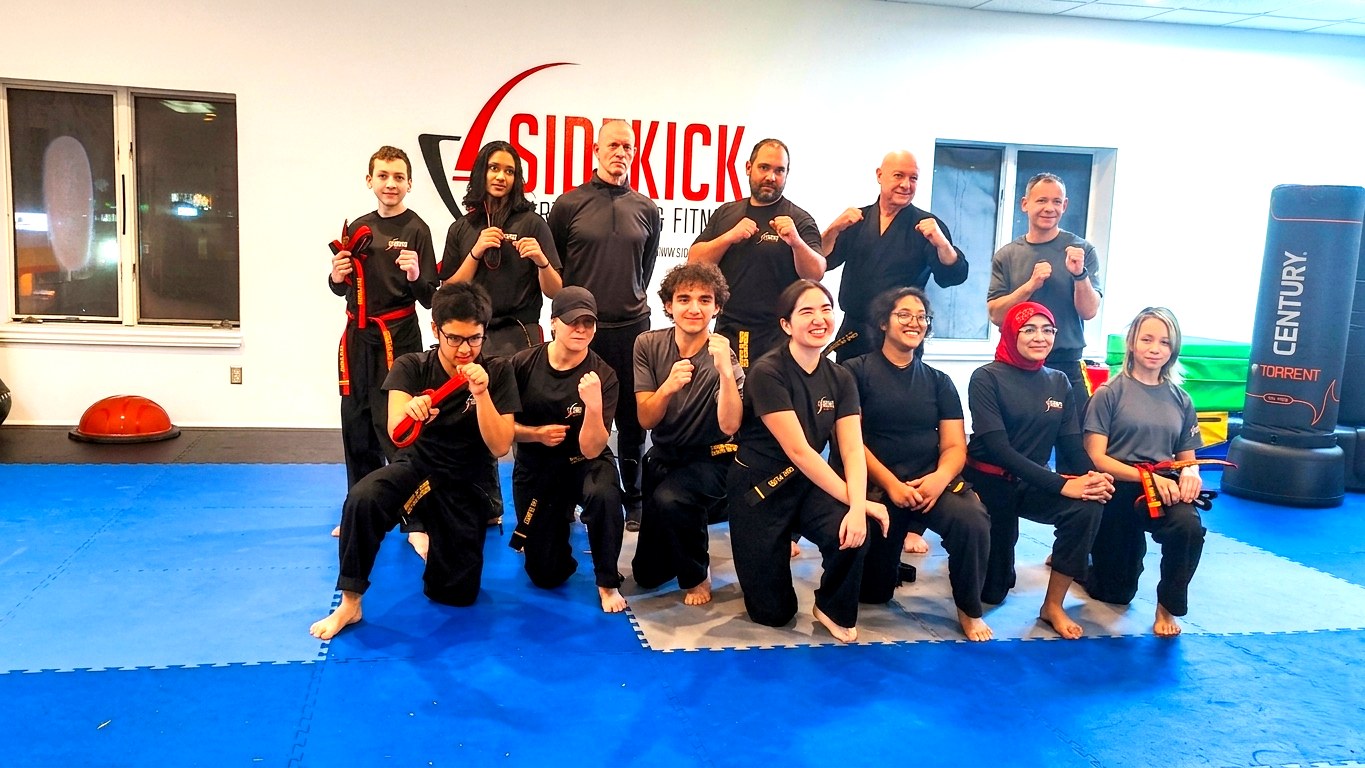
From your first class to your black belt.
Earning a black belt at Sidekick isn't about collecting colored fabric. It's a multi-year journey of skill, discipline, and personal growth - built around a real curriculum that every student follows.
Belts aren't trophies. They're checkpoints.
Some schools hand out belts to keep kids motivated. We don't work that way.
At Sidekick, every belt stands for real skills. Techniques learned, fitness goals hit, and habits built through months of steady training. When your child earns a new belt, they've truly earned it, and you'll both see exactly what it took to get there.
Eight colors. Sixteen levels. One black belt.
Every Sidekick student follows the same path. Each color has two stages - a regular belt and a "High" belt that proves mastery before moving to the next color.
Our belt path is built on Taekwondo. See kids Taekwondo classes
- White
- Yellow
- Orange
- Green
- Blue
- Red
- Brown
- Black
Between each color is a "High" belt - your H-White, H-Yellow, H-Orange, and so on. High belts use the same techniques but require cleaner execution, sharper control, and readiness to advance. That's how we know your child is truly prepared for the next level - not just memorizing moves, but mastering them.
Promotions happen every 3 months.
Time
Students test for the next belt after both 3 months of training and 24 completed classes - whichever comes second. Consistent practice is what builds real skill.
Curriculum
Every belt comes with its own playbook: specific kicks and combinations to master, push-up and flexibility targets to hit, Korean words to learn, and for our younger students, habits like bowing in on time and looking a coach in the eye. It's all spelled out in the Belt Journal so there's no guessing what comes next.
Test day
Tests happen quarterly, and we strongly encourage parents to come watch - and bring grandparents, siblings, aunts, uncles, whoever. Seeing your child stand up in front of family and show off everything they've worked for is one of the proudest moments you'll share together.
A real progression, level by level.
Here's a high-level look at what students focus on at each belt. The full curriculum lives in the Belt Journal for each tier.
White Belt
The Foundation
Stances, basic punches and kicks, first combinations, and an early intro to our signature flying sidekick. Dodgeball is part of class too - it builds reflexes, agility, and teamwork while keeping things fun. Plus the habits that matter: bowing in, listening, focus.
Yellow Belt
Control & Coordination
Building precision. Cleaner kicks, more coordinated movement, and the discipline to repeat techniques the right way. Balance sharpens noticeably - holding kicks longer without wobbling - and flexibility starts to open up through dedicated stretching at every class.
Orange Belt
Movement & Defense
A big jump in curriculum. Multi-strike combinations, ground defense basics, escapes from common holds, intro to sparring footwork, and the start of Kali stick training - a Filipino martial art using rattan sticks that sharpens hand-eye coordination, reflexes, and both-handed dexterity in a way empty-hand training can't. Your kid starts to feel like a real martial artist.
Green Belt
Power & Balance
Generating real power in strikes. This is where we introduce kettlebells - a simple cast-iron weight that builds full-body strength, explosive power, grip, and core stability all at once. They're safe for kids when coached properly and translate directly into harder kicks and stronger stances. Kali progresses with new techniques. This is where the work gets serious.
Blue Belt
Application
Putting it all together. Sparring fundamentals, advanced combinations, more complex Kali sequences, and finally landing the flying sidekick with real height, control, and power.
Red Belt
Mastery in Motion
Refining everything. Speed, timing, and control under pressure. This is also where spinning kicks take center stage - the 360 roundhouse and 360 back kick become signature weapons. Kettlebell strength becomes a key part of training.
Brown Belt
Pre-Black Preparation
The final stretch before black belt. Advanced kicking combinations, harder sparring rounds, weapon defense, and deeper Kali flow drills. Brown belts also start stepping into leadership - mentoring newer students, helping run warm-ups, and setting the tone on the mat. This is where technique, fitness, and character all have to come together.
Black Belt
The Beginning, Not the End
Junior Black Belts assist with classes, lead drills, and become role models for the younger students coming up behind them. Full Black Belts represent the school inside and outside the dojo - in how they train, how they carry themselves, and how they treat people. Earning your black belt isn't the finish line. It's the moment the real martial arts journey begins, with deeper technique, weapons mastery, and the path toward higher dans ahead.
Every student gets a Belt Journal.
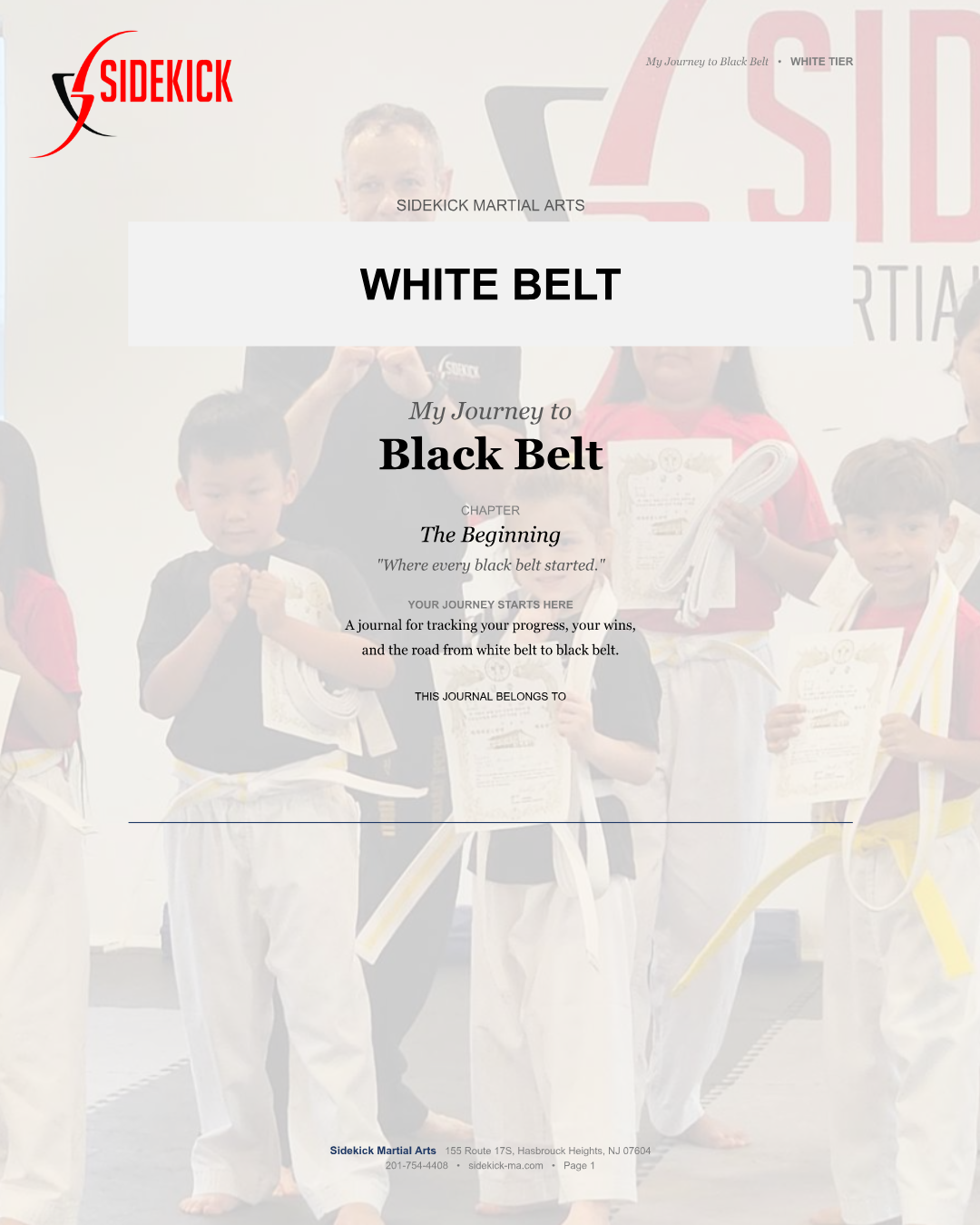
When your child starts at Sidekick, they receive their White Tier Journey Journal - a printed booklet that maps out everything they'll learn over the next six months. Techniques, fitness goals, Korean vocabulary, reflection prompts, and a place to record their progress.
As they advance, they receive a new journal for each color tier. It's not just a curriculum guide - it's a record of their journey, signed by their instructors at every promotion.
Take a look inside.
See exactly what your child will learn at each level. The White Belt journal is free - just enter your email and we'll send it your way. The rest are available to enrolled families in our member portal.
Journey
White Belt Journey
Your child's first 6 months at Sidekick.
Journey
Yellow Belt Journey
Available to enrolled Sidekick families.
Journey
Orange Belt Journey
Available to enrolled Sidekick families.
Journey
Green Belt Journey
Available to enrolled Sidekick families.
Journey
Blue Belt Journey
Available to enrolled Sidekick families.
Journey
Red Belt Journey
Available to enrolled Sidekick families.
Journey
Brown Belt Journey
Available to enrolled Sidekick families.
Journey
Black Belt Journey
Available to enrolled Sidekick families.
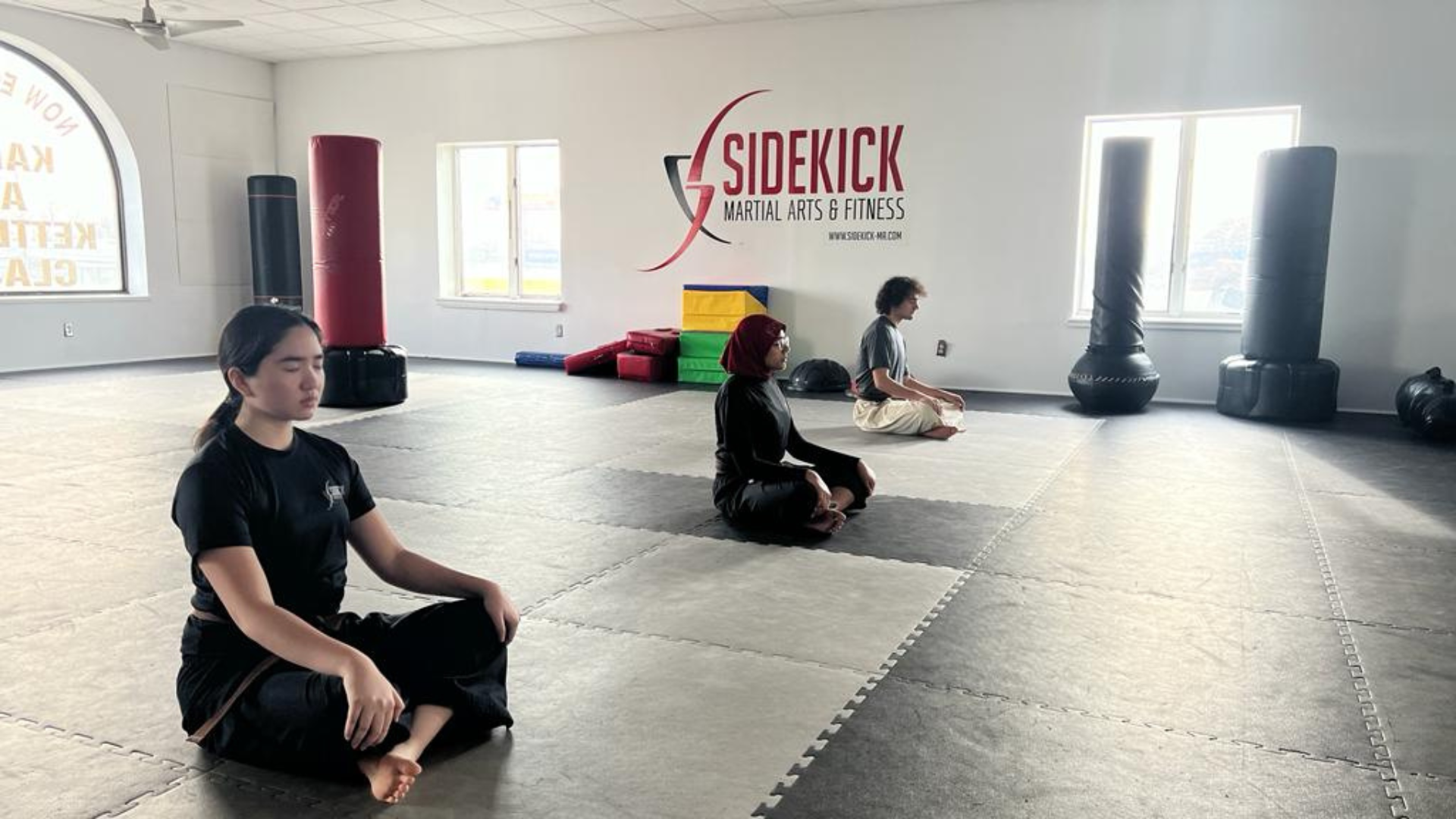
Black belt takes years. That's the point.
On paper, the journey from White to Black is 16 levels x 3 months = roughly 4 years. In practice, most students take longer - and that's normal.
Kids plateau. Life happens. Some students breeze through early belts and slow down at advanced ones. Others train consistently for 5 or 6 years before earning their black belt. What matters isn't speed - it's the kid who shows up, week after week, year after year.
The students we're most proud of aren't the fastest ones. They're the ones who kept going.
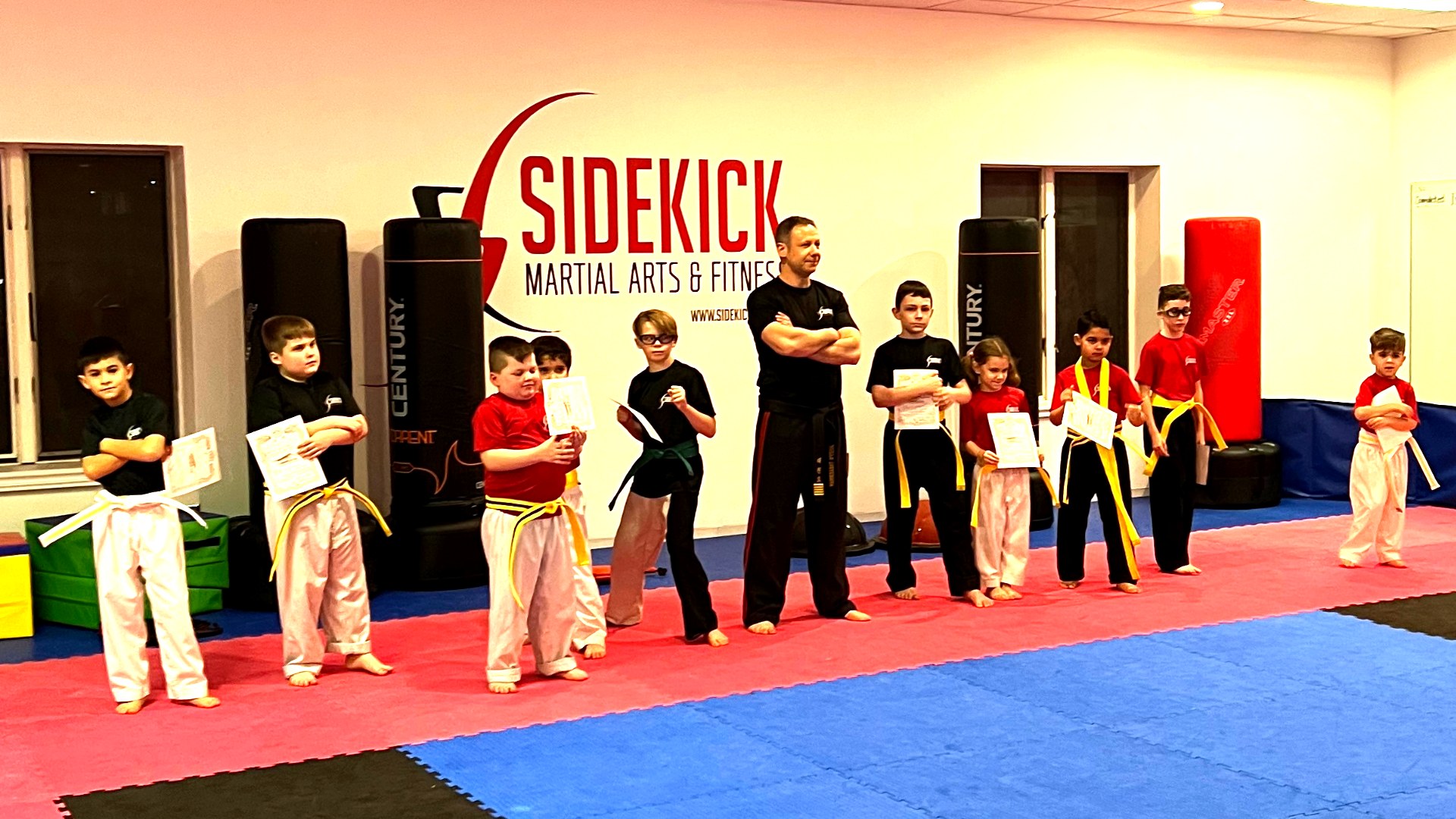
Ready to start the journey?
The first step is a Free Week. No commitment, no pressure - just a chance for your kid to put on a uniform and take their first kick.
Based in Hasbrouck Heights • Welcoming families from across Bergen County